Sabado, Hulyo 9, 2011

the PHILIPPINE flag


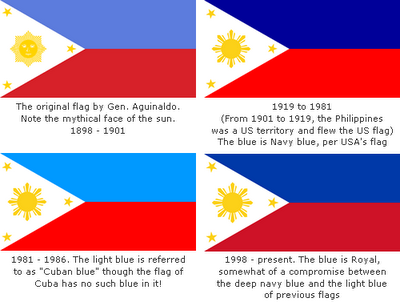
1898. Out of many earlier versions the current national flag of the Philippines evolved first conceptualized by Emilio Aguinaldo, a freemason.

Description:

The National Flag of the Philippines comprises of two stripes of Red forming the upper strip and Blue at the bottom and a White stripe to the left of the flag area. Inside the white triangle is a central golden-yellow sun with eight rays. A five-pointed star is presented in each angle of the triangle.
 

some Heritage that affect the civilization of the PHILIPPINE

1. Historic Town of Vigan ---

The historic Town of Vigan is situated in northeastern part of Luzon and was formerly established as a center of business excellence by the Spanish ruler's way back in 1572. Due to its well planned roads and residential areas, it is considered to be the most well defined model town of a contrived Spanish colonial town. Its wide architectural facets reflect the intermingling of various cultures that made Philippines their home land. Though this historic town has considerable Spanish influence in every sphere yet the dominant exertion of Filipino culture cannot be denied as many of its spectacular old monuments draws its inspiration from the Filipino tradition. The cosmopolitan life style of the town still pre eminent and continues to attract tourist lovers from different corners of the country.

2. Baroque Churches of the Philippines---


The international body of U.N.E.S.C.O declared Baroque Churches of the Philippines as a World Heritage Site in the year 1993. It is actually a collection of four Spanish churches named as--San Agustin Church in Manila, Nuestra Señora de la Asuncion in Santa Maria, San Agustin Church in Paoay, Ilocos Norte and Sto, Tomas de Villanueva Church in Miag-ao, Iloilo. These old churches have played a dominant role in Philippine history and were once considered as the political and social lynchpin of Spanish colonial rule in Philippines. The unparalleled architectural decors of the church are replete with Biblical references from the Latin scriptures. Evidences indicate that these churches were subject to countless attacks and witness to some of the worst revolutions of the country which also to a great extend left behind some indelible marks on its architectural splendor.

3. Rice Terraces of the Philippine Cordilleras---


The world famous Rice Terraces of the Philippine Cordilleras is situated in Ifugao which is believed to be home to the ancient Fillipino culture and other manicured rice terraces formed in midst of mountains. In the earlier days, the inhabitants of Ifugao initiated a planned watershed management system to enhance the growth of these terraces. Geographically, Ifugao, is a land-locked area situated at the foot of the Cordillera Mountain Range, surrounded by the province of Benguet on the west, Nueva Viscaya to the south, Isabela on the east and on to the north lies the Mountain Province.

some Historical place in the PHILIPPINES

The Luneta Park
Located in the capital city, Manila, the Luneta Park was built as a tribute to the greatest hero of the Philippines, Dr. Jose Rizal. Earlier known as Bagumbayan Field, the Luneta Park is one of the leading historical places of the Philippines. This was the historical site where Dr. Rizal was executed by a Spanish military firing squad on 30 December, 1896 because he had spread the ideals of revolution against Spanish rule.

Corregidor
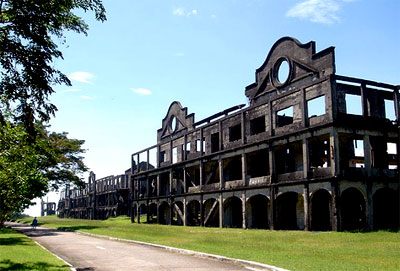

Located in Bataan, Corregidor is one of the major historical places of the Philippines. This is a national shrine and an island fortress which was nicknamed "The Rock". This historical site was the last bastion to succumb to the Japanese invasion in the year 1942. Corregidor attained huge significance as a symbol of the unwavering resistance of the Filipino and American defenders.

Pastor House


Situated on Tirona St in Batangas City, the Pastor House is one of the historical places of the Philippines, which is an illustration of the turn-of- the-century style residence. The Pastor House was originally under the ownership of Mr. Alejo Acosta, who was the barrio Captain of Batangas in the year 1883. It is said that during the visit of the Governor General, William Howard Taft to the house, an attempt was made by a sniper to assassinate him. Evidence of the bullet that would have taken his life is lodged in one of the doors of the house till this date.

Taal Cathedral de San Sebastian

The construction of this historical site of the Philippines had commenced in the year 1756 and took a century to achieve its present form. Rising to an altitude of 95 meters and 45 meters wide, the Taal Cathedral de San Sebastian stands on a plateau in the center of Taal. The cathedral's tabernacle is the only one of its kind in the country. The Taal Cathedral de San Sebastian is one of the leading historical places of the Philippines.

Miyerkules, Hunyo 22, 2011

the PHILIPPINE map


the PHILIPPINES


The Philippines (i /ˈfɪlɨpnz/FilipinoPilipinas [ˌpɪlɪˈpinɐs]), officially known as the Republic of the Philippines (FilipinoRepublika ng Pilipinas), is a country in Southeast Asia in the western Pacific Ocean. To its north across the Luzon Strait lies Taiwan. West across theSouth China Sea sits Vietnam. The Sulu Sea to the southwest lies between the country and the island of Borneo, and to the south theCelebes Sea separates it from other islands of Indonesia. It is bounded on the east by the Philippine Sea. Its location on the Pacific Ring of Fire and its tropical climate make the Philippines prone to earthquakes and typhoons but have also endowed the country with natural resources and made it one of the richest areas of biodiversity in the world. An archipelago comprising 7,107 islands, the Philippines is categorized broadly into three main geographical divisions: LuzonVisayas, and Mindanao. Its capital city is Manila.
With an estimated population of about 94 million people, the Philippines is the world's 12th most populous country. An additional 11 millionFilipinos live overseas. Multiple ethnicities and cultures are found throughout the islands. In prehistoric times, Negritos were some of the archipelago's earliest inhabitants. They were followed by successive waves of Austronesian peoples who brought with them influences fromMalayHindu, and Islamic societies. Trade introduced Chinese cultural influences.
The arrival of Ferdinand Magellan in 1521 marked the beginning of an era of Spanish interest and eventual dominance. Manila emerged as the Asian hub of the Manila–Acapulco galleon fleet. Missionary work led to widespread Christianity. As the 19th century gave way to the 20th, there followed in quick succession the short-lived Philippine Revolution, the Spanish-American War, and the Philippine-American War. In the aftermath, the United States replaced Spain as the dominant power. Aside from the period of Japanese occupation, the United States retained sovereignty over the islands until the end of World War II when the Philippines gained independence. The United States bequeathed to the Philippines the English language and a stronger affinity for Western culture. Since independence the Philippines has had an often tumultuous experience with democracy, with popular "People Power" movements overthrowing a dictatorship in one instance but also underlining the institutional weaknesses of its constitutional republic in others.